Bitcoin ETFs Lose $1.62B Basis Trading Crash

Journalist
Hassan Shitu

Journalist


Share


Funds traded on the Bitcoin spot exchange experienced higher inflows over four trading days, losing a total of $1.62 billion.
The exit raised questions about whether hedge funds are reducing their Bitcoin exposure as market conditions change.
The funds come as bitcoin has failed to regain momentum around key price points and the once-popular institutional arbitrage strategy is losing its appeal.
BlackRock's IBIT Leads Bitcoin ETF As BTC Slips Below $90K
Since Jan. 22, 2026, U.S.-listed spot Bitcoin ETFs have recorded net daily inflows of $32.11 million, extending their redemption streak to $708.71 million on Jan. 21, following $483.38 million on Jan. 20, SosoValve data shows.
In the last one week, the net flow reached 1.22 billion.
Trading activity remained strong on January 22, with Bitcoin spot ETFs recording $3.30 billion in volume, although assets under management fell to $115.99 billion, about 6.49% of Bitcoin's market cap.
BlackRock's iShares Bitcoin Trust led daily flows, returning $22.35 million, equivalent to roughly 249.5 BTC.
Despite the exit, IBIT remains the dominant product, holding $69.84 billion in assets and nearly 4% of the Bitcoin supply in ETFs.

Fidelity's FBTC followed with $9.76 million in outflows, while Grayscale's GBTC reported daily inflows but remained deeply negative overall, with $25.58 billion in cumulative net inflows as investors shunned the top 1.5% fee.
Other issuers, including Bitwise, Ark and 21Shares, VanEck, Invesco, Valkyrie, Franklin and WisdomTree recorded mostly unchanged flows, not a broad panic sell-off but a pause.
The ETF's return has been stretched alongside weakness in Bitcoin's price.
BTC was trading at $89,982 on January 22, down 1.3% on the day and up nearly 5% last week, after briefly dipping to $88,600.
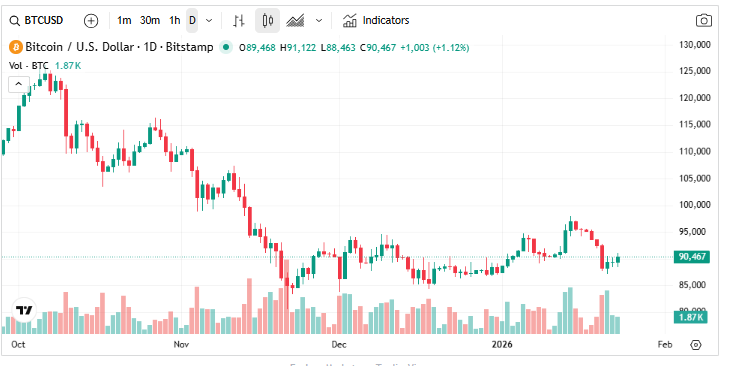
Trading volume also slowed, falling nearly 28 percent to $37.77 billion, a sign of declining market participation as prices strengthened below $90,000.
Compressed Yield Triggers Hedge Fund Exit from Bitcoin ETFs
Market observers point to hedge fund positioning as a key driver behind ETF flows.
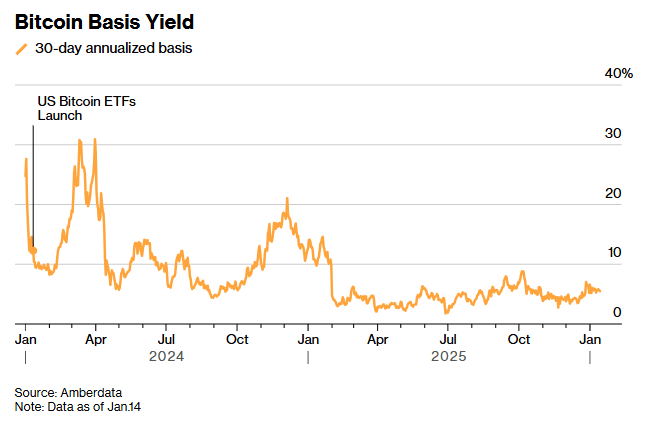
Amberdata, a strategy that sells futures to capture price spreads, trades on the basis of Bitcoin, falling to less than 5% from around 17% a year ago.
As yields compress and short-term U.S. Treasuries approach yields, there is less incentive for fast-moving capital to remain active.
The analyst noted that while hedge funds represent only 10% to 20% of ETF owners, their activity could choke the flow in the short term when trading stops.
The wind is also visible in primary markets, according to Bloomberg data.
Demand for bitcoin futures on the Chicago Mercantile Exchange (CME) fell below Binance for the first time since 2023, as participation in cash and carry trades by U.S. institutions declined after the ETF launched there.
The one-month annualized yield now hovers around 4.7%, just clearing funding and execution costs, as spreads tighten and arbitrage opportunities fade.
CryptoQuant indicators show that demand is turning negative, whale and dolphin wallets are shifting from accumulation to distribution.
Also, the Coinbase premium has remained deeply negative, indicating weak appetite from US institutions.
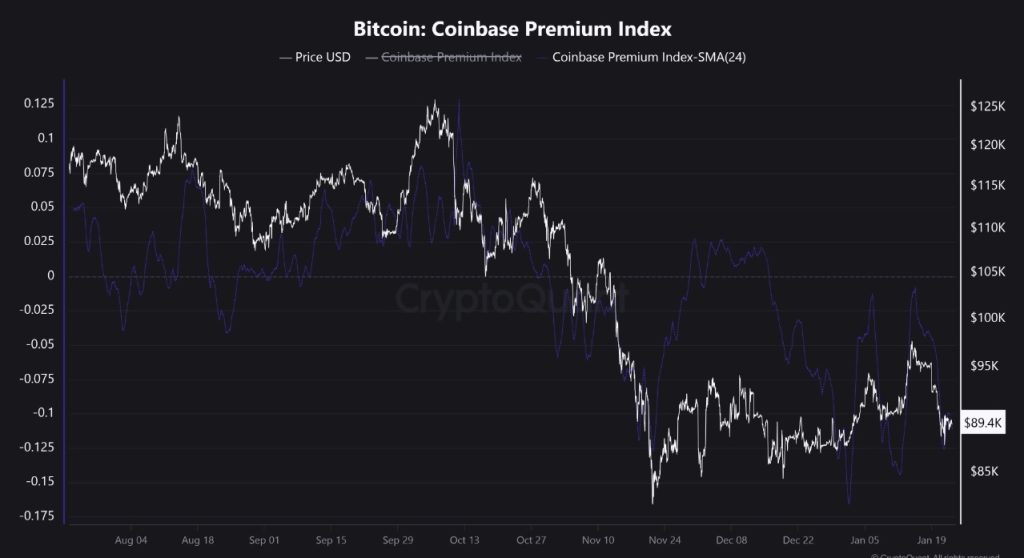
At the same time, leverage in Bitcoin futures rose to its highest level since November.
Flows in other crypto ETFs underscore that the sell-off is not uniform.
Ethereum spot ETFs saw significant outflows this week, including $41.98 million on Jan. 22, while XRP and Solana-linked products saw moderate outflows, pointing to a selective institutional position rather than a mass exit from digital assets.
Trending news, recommended popular crypto topics, price predictions