Brent Crude hits $82, but risks remain.

Oil prices rallied sharply this week after the Middle East conflict pushed Brent crude futures (ICEEUR:BRN1!) to $82, marking their biggest shock in months. Brent is a widely used international oil benchmark for international crude prices, which makes the oil price response to geopolitical risk very clear.
The gap is tracked on CFD (Contract for Difference) charts, which reflect the price structure but not the actual positions. However, futures data from ICE Futures Europe confirmed that real traders entered the market, confirming the rise in oil prices as a geopolitical and position-specific move.
Rising oil prices and a rising dollar will create early stress at $82
Oil prices rose from $72 to $82 after the US-Israeli attack on Iran. The retaliation raised fears of a supply cut in the Strait of Hormuz, which transports nearly a fifth of the world's oil. This sudden increase in prices increased the war premium, meaning that traders raised the price of oil not because of an immediate shortage but because of an anticipated supply threat.

This shock caused a gap in Brent crude oil. Such moves are often stressed early as markets want to retest part of the jump before continuing higher.
That concern appeared around $82 when Brent crude oil corrected to $79.
The recent candle closes red with high volume. Volume in red indicates that additional trading occurred as oil prices corrected after the break, indicating active selling pressure.
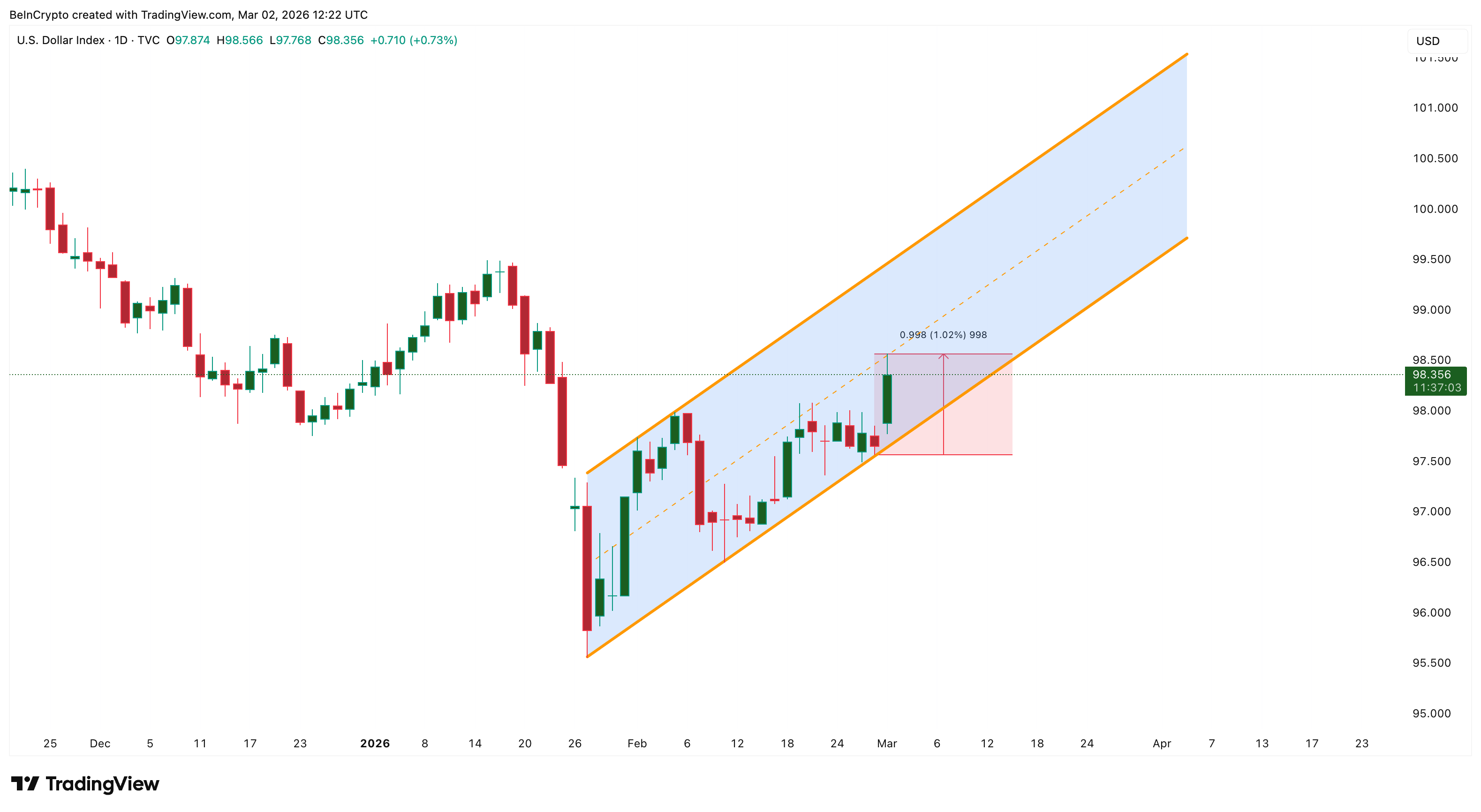
Similarly, the dollar index (DXY), which tracks the dollar's strength against major currencies, has been rising. Because oil is traded globally in dollars, a stronger dollar makes oil more expensive for international buyers. A sign of depression.
But another key indicator shows the whole picture. Open interest, often referred to as OI, has increased sharply in Brent futures (ICEEUR:BRN1!). An increase in open demand means that new traders are entering the market instead of closing positions. This confirms the short-term bullying bias.
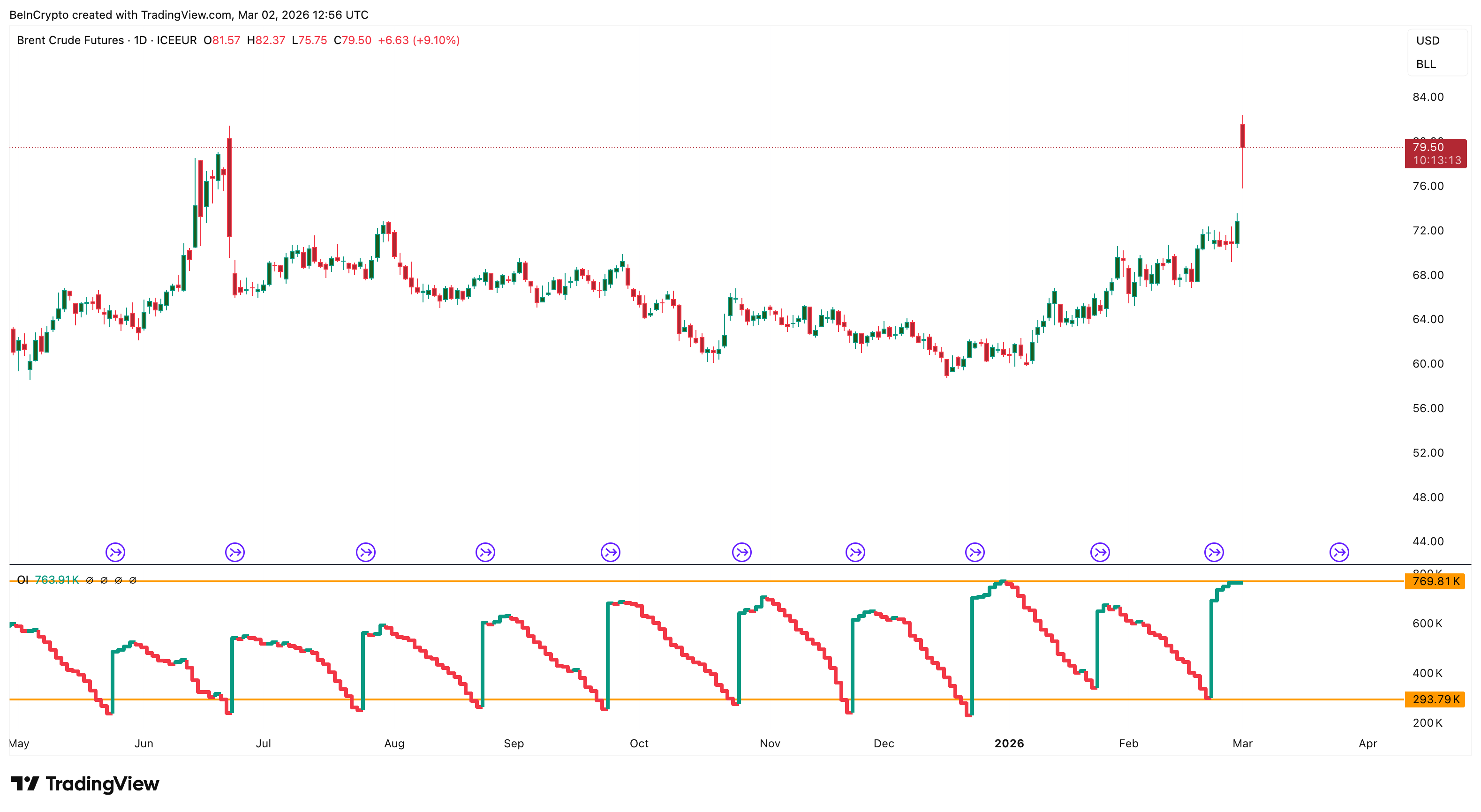
This shows that fuel prices are not falling due to lack of interest. Instead, the market is taking a selloff as new positions continue to build. However, traders should monitor the flat open demand.
A rise in prices while open interest is flat means the action is likely to be short covering, not new buying.
OPEC's supply increase will increase future risk even as the war is pushing up current prices
At the same time, OPEC announced that it will increase production by 206,000 barrels per day from April. OPEC is a group of major oil producers that control the majority of world supply.
Because more oil is available, higher supply usually lowers the price of oil.
However, oil prices continue to rise because the threat of war will affect supply immediately, while an increase in OPEC production will occur later. This creates a conflict between short-term supply fears and long-term supply growth.
The Gulf of Hormuz remains central to this risk. Even the possibility of a disruption is enough to make traders cautious and keep pressure on oil prices. This also explains why open interest started and why selling pressure occurred after the gap opened, because when traders are careful to push oil prices higher, there is a higher chance of sudden supply and macro shifts.
The futures position shows that the market is preparing for a big oil price movement
The future position shows that the deterioration of oil prices is attracting strong participation. The sharp increase in open interest in Brent Crude Oil Futures (ICEEUR: BRN1!) earlier confirmed that traders are actively opening new positions as volatility increases.
This positioning trend is spreading beyond traditional markets. As Aster, a crypto-based derivatives exchange, has launched oil futures.
The increase in oil trading on crypto platforms shows how widespread the position is. It reflects a broad position in the financial markets.
Key oil price levels are tracked using Brent Crude CFDs and Brent Crude Oil Futures are used to track volume and open demand.
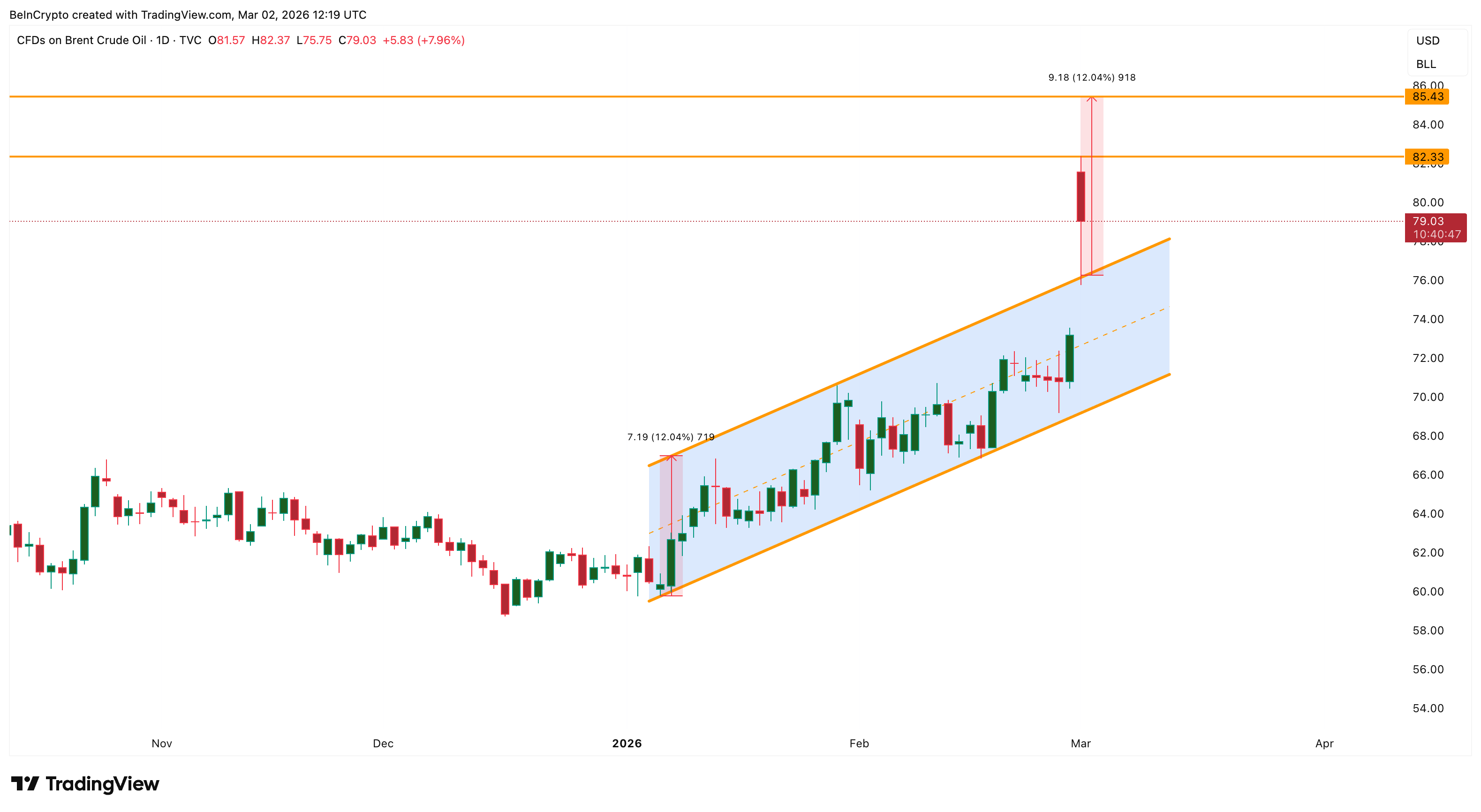
According to the chart, the first resistance remains at $82, which coincides with the Fibonacci retracement (mentioned later).
If the oil price breaks above $82, the next target will be $85, according to the forecast of an upward channel breakdown. If the geopolitical risk continues above that, the next resistance levels will be seen at $93 and $104. Adding to this current strength is the position of the Exponential Moving Average (EMA).
It measures the average price over time while giving more weight to recent data, and recently confirmed a golden crossing where the 50-day EMA crossed above the 200-day EMA, a signal that previously preceded a recent upward move. The 100-day EMA is now rising to the 200-day EMA, which is showing trend support.
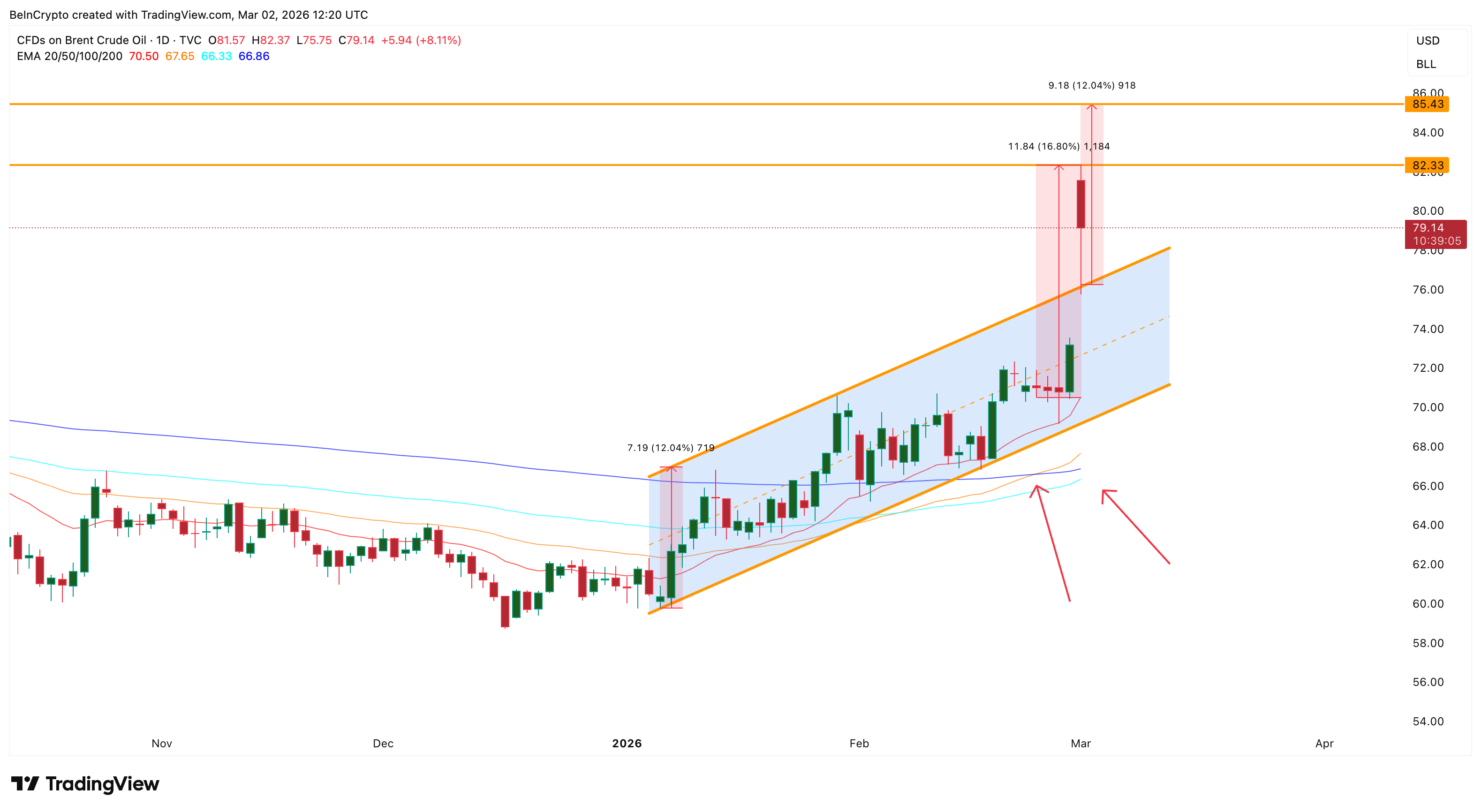
If that bearish cross confirms, the $85 target could be seen first, based on an upward channel projection.
However, the most important support level is $75.
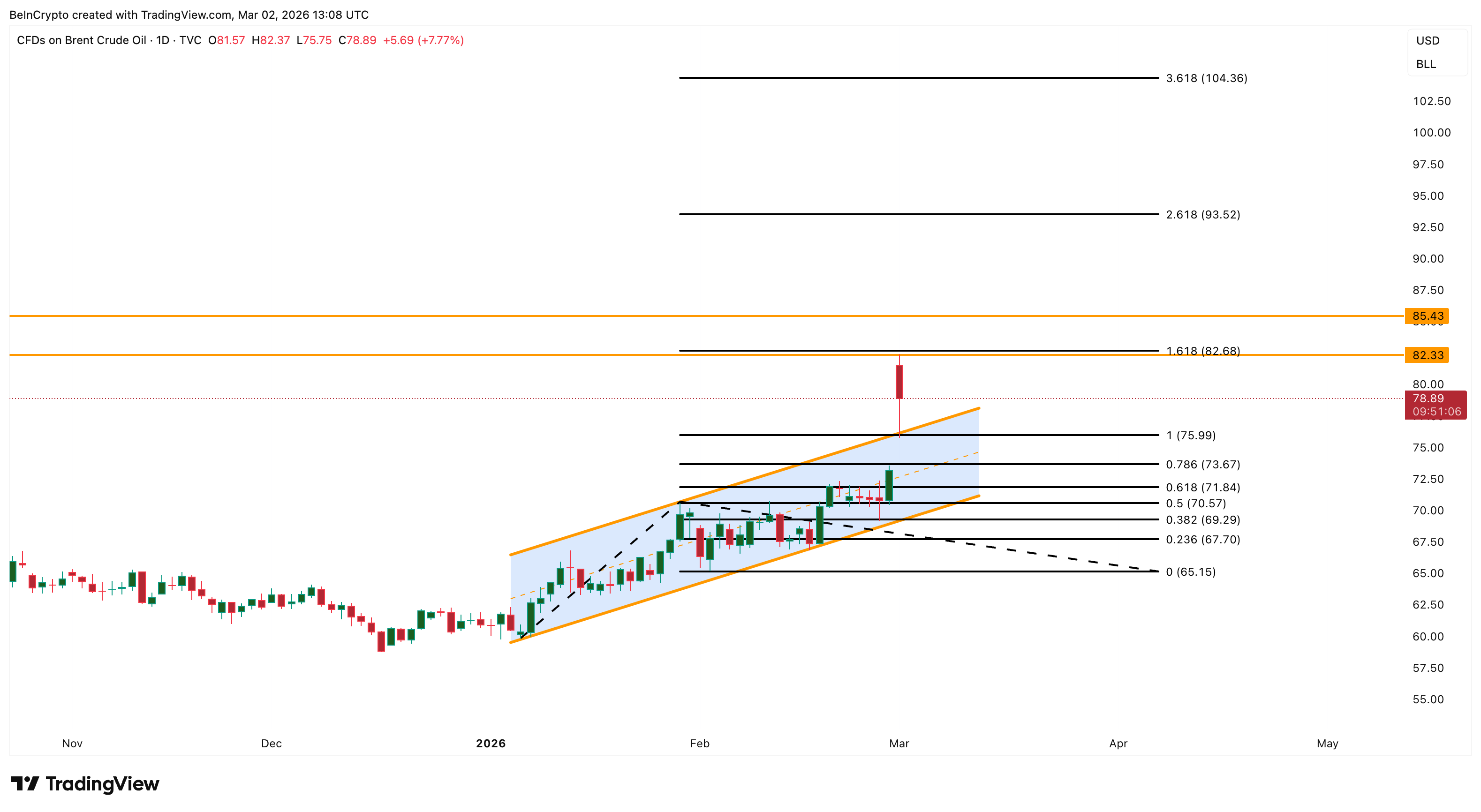
If the price of oil is below $75, it may drop to $73 and $71. However, the bullying structure will only be weakened by possible peace talks and a sub-$67 scam.