Capital inflows into Bitcoin have dried up, says CryptoQuant CEO.

Crypto journalist
Anas Hasan

Crypto journalist


Share


CryptoQuant CEO Ki Yang Ju stated that the various liquidity channels and institutional long-term holding strategies have fundamentally changed the traditional market cycles, and the flow of Bitcoin capital has completely dried up.
The reversal marks a departure from historical patterns in which the whale selling was driven by a retail-based crash, suggesting a longer sideways trading period than the deep 50%-plus corrections seen in previous bear markets.
Ju emphasized that institutional treasury holdings, particularly MicroStrategy's 673,000 BTC position, avoided the typical well-retail sell-off that had previously dominated market volatility.
Capital has turned to traditional stocks and precious metals, creating “boring sideways” price action for the coming months.
Despite price volatility, whale behavior signals market health
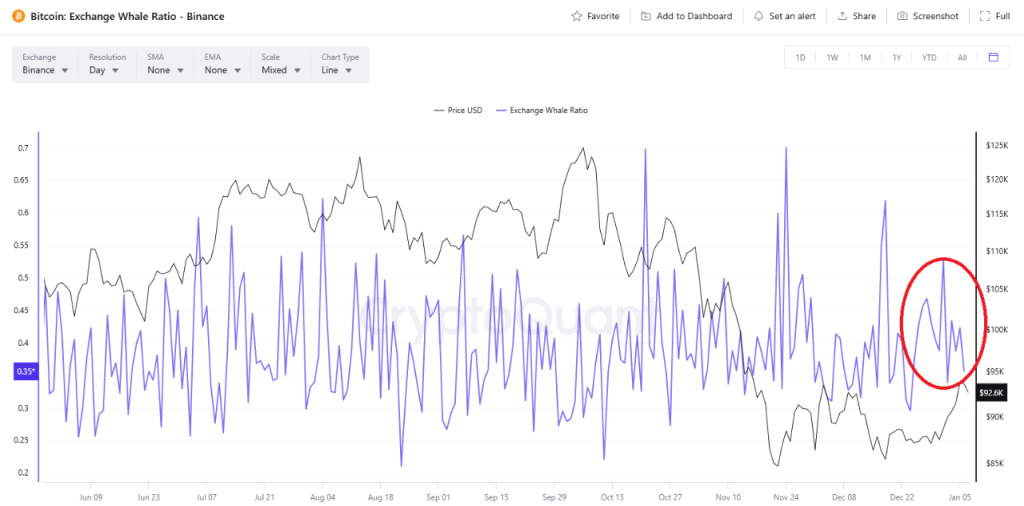
Although Bitcoin has rebounded from recent lows, whale exchange activity has decreased rather than increased, bucking historical patterns where high investor interaction with exchanges has resulted in higher selling pressure.
CryptoQuant data shows that even after the price recovery, whale participation remains relatively low.
This indicates limited distribution pressure from major holders, which is consistent with what analysts describe as a “structurally sound” market environment.
Retail investors are also notably absent from the current recovery phase, with Bitcoin's 30-day retail investor demand swing turning negative, according to CryptoQuant analyst Martin.
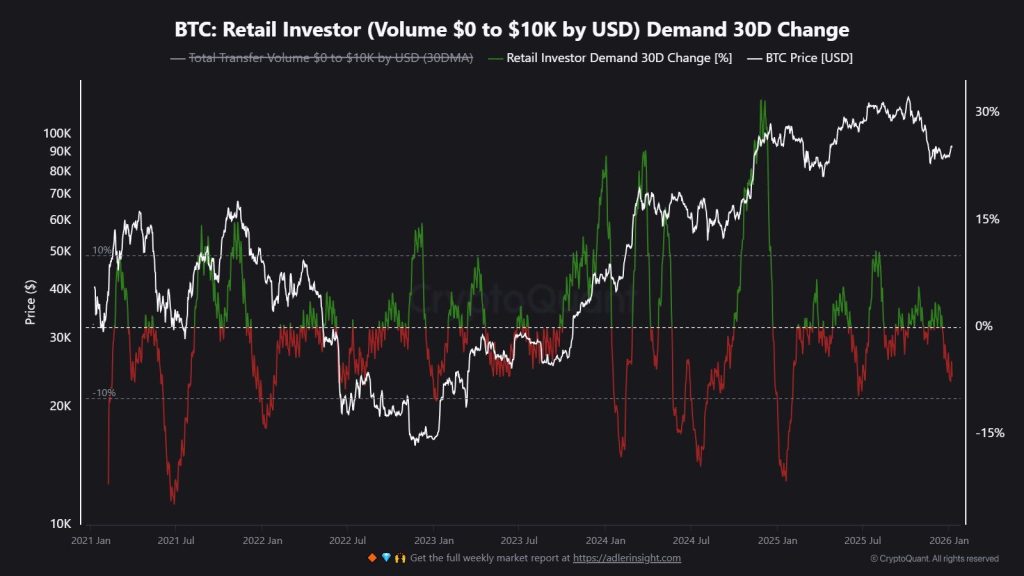
“Retail is still on the move,” Martin said, stressing that despite recent price stability, the public has not returned to the market.
With little participation from the general public and no clear push from whales, the market is stuck in an unusual situation where retailers and large owners seem hesitant.
In the midst of all this, Bitcoin recently fell below $90,000 and filled its first CME gap, adding to the uncertainty over whether the price could slide further towards $88,000.
The institutional setting shows early signs of recovery
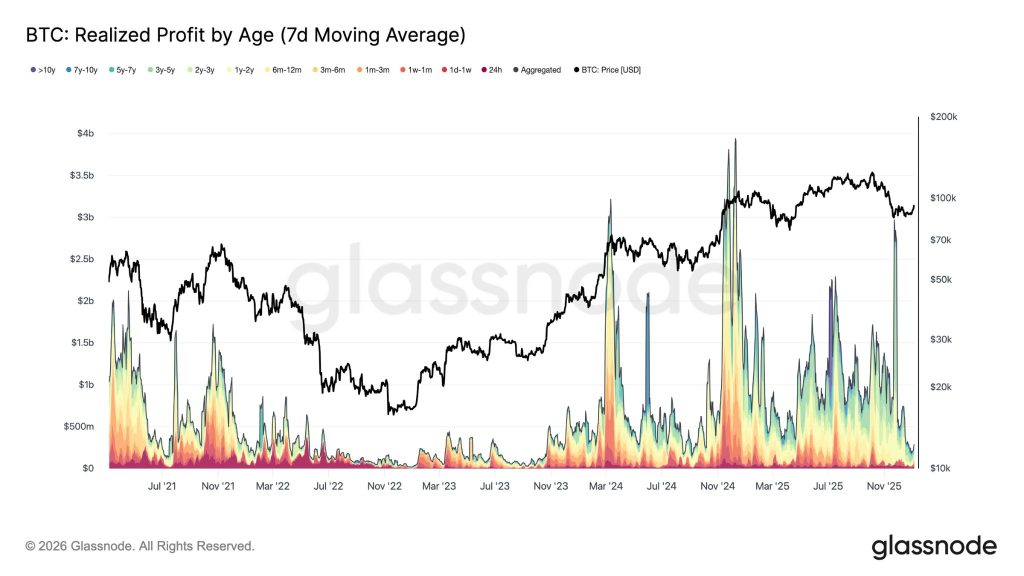
Taking a closer look, Glassnode reported that Bitcoin entered 2026 following critical decline and consolidation phases, with on-chain metrics indicating profit-taking pressure and structural stability at the lows of the current range.
“The realized profit (7D-SMA) at the end of December 2025 fell to $183.8M per day, down from a high of over $1B per day seen in Q4.
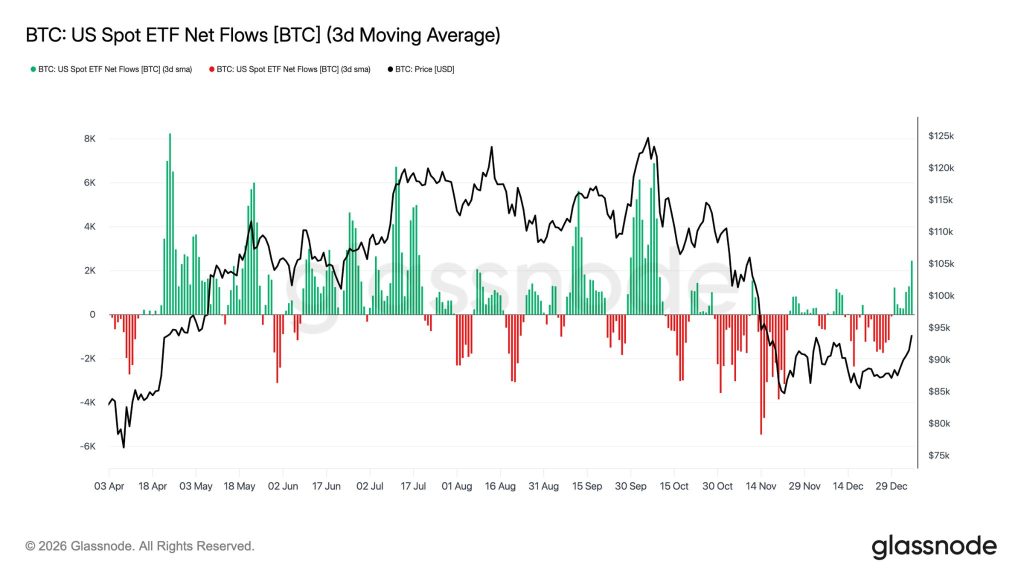
US spot ETF flows have re-emerged in late 2025, with futures open interest stabilizing and beginning to rise after a cycle peak of more than $50 billion.
“Positive pressures have been increasing, indicating that ETF participants are shifting from net distributors to margin accumulators,” Glassnode said, describing the shift as a constructive tailwind of renewed interest in the institutional space.
In particular, the largest options on record cleared more than 45% of their best positions after a reset of open interest on the Dec. 26 expiration, which eliminated structural hedging restrictions.
“Open interest decreased from 579,258 BTC at the end of December 25 to 316,472 BTC at the end of December 26,” Glassnode explained, explaining the reset as “an emotionally cleaner reading, as new positions now reflect new premiums to buy or sell rather than legacy exposure.”
Glassnode analysts also noted that the dealer gamma has briefly reversed between $95,000 and $104,000, with New Year's options flows increasingly moving to calls rather than defenses.
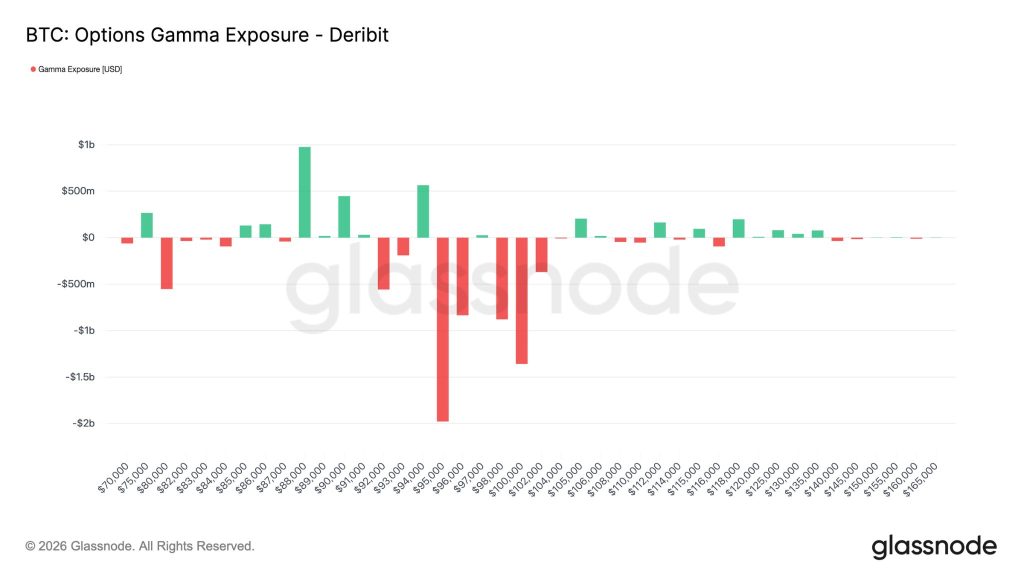
They concluded that demand for corporate Treasuries continued to provide stabilizing support below the price.
However, rather than being permanently structural, it remains sequential, with accumulation clustered around local weaknesses.
Capital rotation and long-term perspective
Speaking to Cryptonews, VALR CEO Farzam Ehsani said Bitcoin's integration into precious metals, gold and silver, has increased 69% and 161%, respectively, over the past year.
“Bitcoin and ETH will see capital gains after the precious metals rally is over,” Ehsani explained, once the precious metals momentum fades to $130,000 for Bitcoin and $4,500 for Ethereum in Q1 2026.
In contrast, early Bitcoin investor Michael Terpin offers a different perspective, suggesting that 2026 could mirror years like 2014, 2018 and 2022.
“If prices follow historical patterns, we should clear around $60,000 by early fall,” Terpin said, though he acknowledged that an extended bull cycle could peak about 20% before the final correction.
However, Ju offered a long-term perspective on patience, comparing Bitcoin investment to aging whiskey.
“You need at least four years to get to the bottom,” he said, urging investors to consider a 16-year holding period to 2042 rather than focusing on short-term volatility.
Trending news, recommended popular crypto topics, price predictions