Crypto Twitter Blasts With Binance Scam Allegations: What’s the Truth?

Crypto Twitter is furious again. This time the target is known: Binance, the world's largest crypto exchange and co-founder Changpeng Zhao (CZ).
Over the past few days, major accusations have taken to Twitter (or X) timelines, with some users calling him a “fraudster” and calling for him to “go back to jail.” So what's behind the latest allegations and how much of it is backed up by credible evidence?
October Market Crash: What Happened?
One of the most serious allegations against Binance came in October, during what later became known as “Crypto Black Friday”.

On October 10, US President Donald Trump announced 100% tariffs and export controls targeting China. The announcement immediately jolted global markets, significantly reducing risk capital.
Crypto was no different. According to BeInCrypto, Bitcoin fell by around 10%. Major altcoins followed: Ethereum (ETH), XRP (XRP) and BNB (BNB) each fell more than 15 percent.
More than $19 billion in leveraged positions were released in 24 hours, the largest liquidity event tracked by crypto data analytics firm CoinGlass.
Initially, the crash was seen as a market shock triggered by macroeconomic news. However, market participants soon began to question whether the decline was purely organic.
Sponsored
Traders on social media speculated that the volume and speed of the outflows suggested something more orchestrated than a normal sell-off. Attention soon turned to Binance.
Why Binance became the focus
At the height of the crisis, Binance users reported frozen accounts and failed stop-loss orders and problems accessing the platform. Some traders have pointed to short flashes pushing assets such as Engin (NJ) and Cosmos (ATOM) to zero.
BeInCrypto reports that three Binance-listed assets, including USDe, wBETH and BNSOL, temporarily lost their pegs in the upheaval.
Binance officially acknowledged the outages during the event. The exchange cited “severe market activity” as the cause of system delays and display problems and reiterated that users' funds are SAFU.
Still, the explanation failed to appease all critics. Some users have accused Binance of taking advantage of the trading freeze, allowing the exchange to profit during periods of peak volatility.
Has Binance's compensation strategy worked?
On October 12, Binance issued a statement following an internal review of the incident. As with the exchange, the core Spot and Future matching engines, as well as API trading, are still operational.
“According to the data, the volume of forced liquidation made by the Binance platform is relatively low compared to the total volume of transactions, which shows that this volatility is mainly dependent on the general market conditions,” he said.
However, Binance acknowledged that certain platform modules experienced brief technical outages after 21:18 UTC on October 10 and that some assets experienced crashes due to high market volatility.
Within 24 hours, Binance announced that it had completed compensation for affected users, distributing approximately $283 million in two categories.
Two days later, on October 14, Binance launched a $400 million funding initiative. The package includes $300 million in refund vouchers for affected traders, while the rest is earmarked for low-interest institutional loans.
While Binance was at the center of the community upheaval, it wasn't the only platform affected by the disaster. Other major exchanges, including Coinbase and Robinhood, have also reported service disruptions.
Coinbase's Bitcoin trading activity also came under scrutiny, although no concrete evidence linked it to market manipulation or triggering the crash.
It should be noted that the investigation continued in the weeks following the accident; Some earlier claims were later re-evaluated. A trader who publicly sued Binance later retracted those claims.
After reviewing the technical information provided by the exchange, the trader found that Binance's logs did not show any system errors. He subsequently deleted the original post, stating that he did not want to contribute to the spread of unverified information.
My main argument was ‘API commands failed and discount only commands returned 503 error'. But the technical team of Binance provided complete logs during our meeting, which showed that the orders to be reduced never encountered the 503 error. An investment firm associated with a friend also joined the investigation. “The main account management team and their responsible staff have reviewed the global logs and confirmed that there are no 503 errors for discount-only orders,” he wrote.
Why Binance Backlash Resurfaced in January 2026
For a while, the dust seems to have settled. Then came 2026, and the charge came roaring back. This had a lot to do with how the crypto markets performed in the months after October.
Sponsored
After the massive transfer event, the market is under pressure. Bitcoin and Ethereum gave up all their 2025 gains and closed the year in the red. Market experts pointed to the fall in October as a key reason behind the sector's muted performance.
According to BitMine Chairman Tom Lee, “Many exchanges and market makers…
The discussion intensified after a recent comment by Kathy Wood, CEO of Arc Invest. In a recent interview with Fox Business:
“What we've had in the last 2-3 months are comments after the 10/10… October 10…….. October 10…….. flash crash related to a software problem at Binance that took down the system, and at $28 billion, a lot of people were affected.
Not long after, other industry figures weighed in. OKX founder Star Shu commented that people “underestimated the impact of 10/10”, saying the crash caused “real and lasting damage” to the crypto industry.
An industry-leading company must prioritize core infrastructure, the trust of consumers and regulators, and the long-term health of the ecosystem. Without mentioning specific firms, Xu contrasted that optimism with a growing focus on short-term profits.
“Instead, some have chosen to pursue short-term gain – repeatedly opening Ponzi-like schemes, promoting a few “get-rich-quick” narratives and directly or indirectly driving the price of low-quality tokens, attracting millions of users to their assets linked to them. This has become their shortcut – not to gain legitimacy and the attention of users. Accountability, but brutally Narrative control and integrated influencer campaigns,” added the executive.
Binance faces trader lawsuits.
Market watchers began circulating what they said was evidence of Binance's demise.
In a post by X (formerly Twitter), Star Platinum noted that Binance's October 6 announcement will update the price source for BNSOL and wBETH, with the update scheduled for October 14.
Starplatinum moved more than $10 billion in the 24 to 48 hours before the event, including large flows of USDT and USDC into hot wallets.
The analyst also explained that the USD flows are tied to wallets that he calls Biance-linked. The analyst compared the situation of Binance with Coinbases and said:
“Coinbase does not list weak links (USDe / wBETH / BNSOL), but it did two things: 1,066 BTC moved from cold to hot minutes before the freeze ($130M at pre-crash prices). During the crash, the large flow that failed to fill on Coinbase seems to have been caught by market makers (Prime-style's diversion w Coinbases, Coinbases diversion). It crashed.
Starplatinum also noted that major market makers such as Wintermutt and Jump appear to have limited activity during periods of extreme volatility in USDE, wBETH and BNSOL.
Sponsored
“Put bids in those books when Binance bails out of those books and the liquid engine eats itself,” the analyst said.
They also alleged that a new account made up to around $1.1 billion in BTC and ETH shorts in the two hours before the crash, with one ETH position rising about a minute before the key post, yielded an estimated profit of $160 million to $200 million.
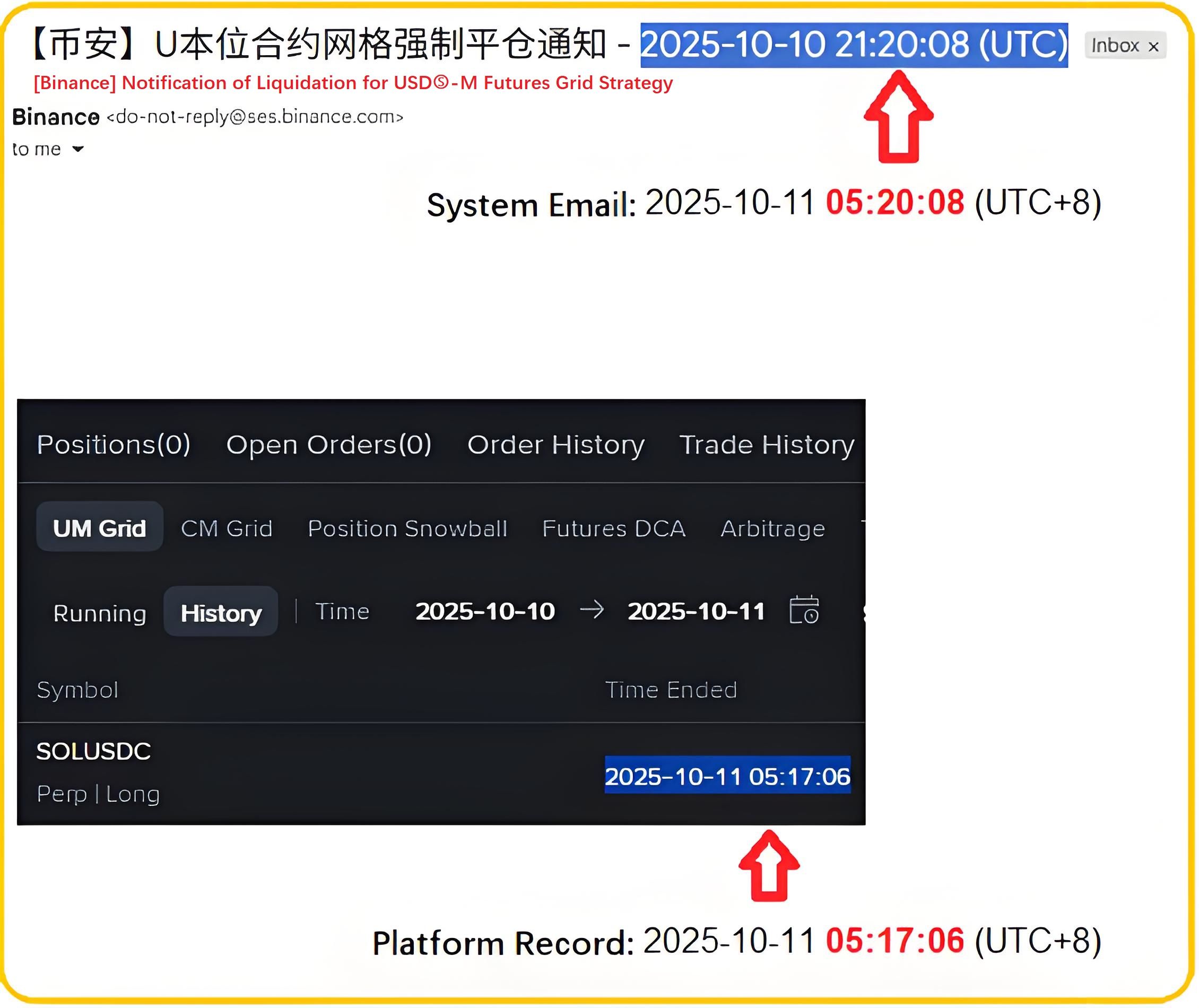
Another user accused Binance of using liquid timestamps. According to the user, Binance has announced that it will compensate any liquidations that occur after 05:18 (UTC+8) after the crash.
However, the merchant liquidation was registered on the platform at 05:17:06, putting it outside the window of relevance.
The trader notes that this timestamp conflicts with the automated system email showing a liquidation launch time of 05:20:08 (UTC+8), which is approximately three minutes apart.
“This self-generated, tamper-proof email is the most metal proof. This is the essence of crypto: Code Is Law,” he wrote.
Meanwhile, Binance's own statement mentioned a different timeframe:
“All futures, margin and credit users who held USDE, BNSOL and WBETH as collateral and were affected by the dipeg effect between 2025-10-10 21:36 and 22:16 (UTC) will be compensated with the settlement fees incurred,” the exchange said.
Crypto Twitter explodes with “fraudulent” claims against CZ
As these claims spread, it didn't take long for the tone on social media to escalate. Users began sharing lengthy posts labeling CZ a “scammer” and accusing him and Binance of systematically undermining their market dominance by undermining competitors and retailers.
Several posts received a lot of attention as community members bolstered their claims and voiced their support. As engagement grew, the lawsuit became a frequent occurrence on Crypto Twitter timelines.
In an interview with BeinCrypto, NoOnes CEO Ray Youssef described Binance as a US-aligned tool for what he called the “controlled dismantling” of the crypto market.
Youssef Zhao pointed out that he aligned himself with the US establishment, which now makes him a real force influencing the direction of Binance.
For Yusuf, Binance's growing relationship with the United States is a concern. He said the exchange had become a controlled asset that could ultimately trigger or accelerate a broader market crash.
“Binance is becoming the next FTX or what FTX should have been… When CZ burst the bubble on FTX, the damage was basically 1% of what the state planned. Now they use Binance to blow that corpse right in our faces.”
Sponsored
Criticism also permeated Zeon's recent comments on its buy-and-hold strategy.
“I've seen many different trading strategies over the years, very few can beat the simple ‘buy and hold'. That's what I do. It's not financial advice,” CZ wrote.
The comments prompted a quick response. Critics have pointed to the performance of tokens listed on Binance, with many stating that they have lost significant value and questioning whether the buy-and-hold approach is realistic for retail users.
“The biggest fraud exchange to ever come out, every project should apply for delisting from binance,” said one analyst.
However, BeinCrypto's report shows that the weakness was not a specific exchange. In the year Crypto tokens listed on major platforms have largely struggled to maintain positive price performance in 2025.
Regardless of the exchange's trend, it reflects the decline in the market rather than issues related to any single trading position.
That's not all. Users also accused Binance of selling Bitcoin during the market crash today.
Binance and CZ issue reaction backlash on Crypto Twitter
However, as the backlash increased, Binance moved to project strength. The exchange has announced that it plans to convert the entire $1 billion holdings of the Secured Asset Fund for Users (SAFU) from stablecoins to Bitcoin over the next 30 days.
In an open letter to the community, he emphasized that Binance “holds itself to high standards” and “constantly improves based on feedback” from users and the general public.
The exchange continues to invest in risk management, compliance and ecosystem development through 2025, citing a series of highlights:
Binance said it helped recover $48 million in 38,648 mistaken user deposits. It added that it has helped 5.4 million users and prevented an estimated $6.69 billion in fraud-related losses. He said he contributed to the seizure of $131 million in illicit funds by cooperating with law enforcement agencies. In the year By 2025, spot lists will contain 21 blockchains led by Ethereum, BNB Smart Chain and Solana. It reported a total of $162.8 billion in reserve verification across 45 crypto assets.
A personal response also came. CZ weighed in publicly, dismissing the latest allegations as usual.
“Not the first, won't be the last time. He's been on the receiving end of FUD attacks since day 1. He'll respond tonight at the AMAs, see why and how below,” he shared.
The renewed investigation of Binance reflects more than one incident or claims. It highlights how fragile trust in crypto is after years of volatility, leveraged crashes and high-profile failures.
In a market still struggling to recover, unresolved questions resurface.