Hong Kong is set to issue its first stablecoin licenses in March 2026.

Journalist
Hassan Shitu

Journalist


Share

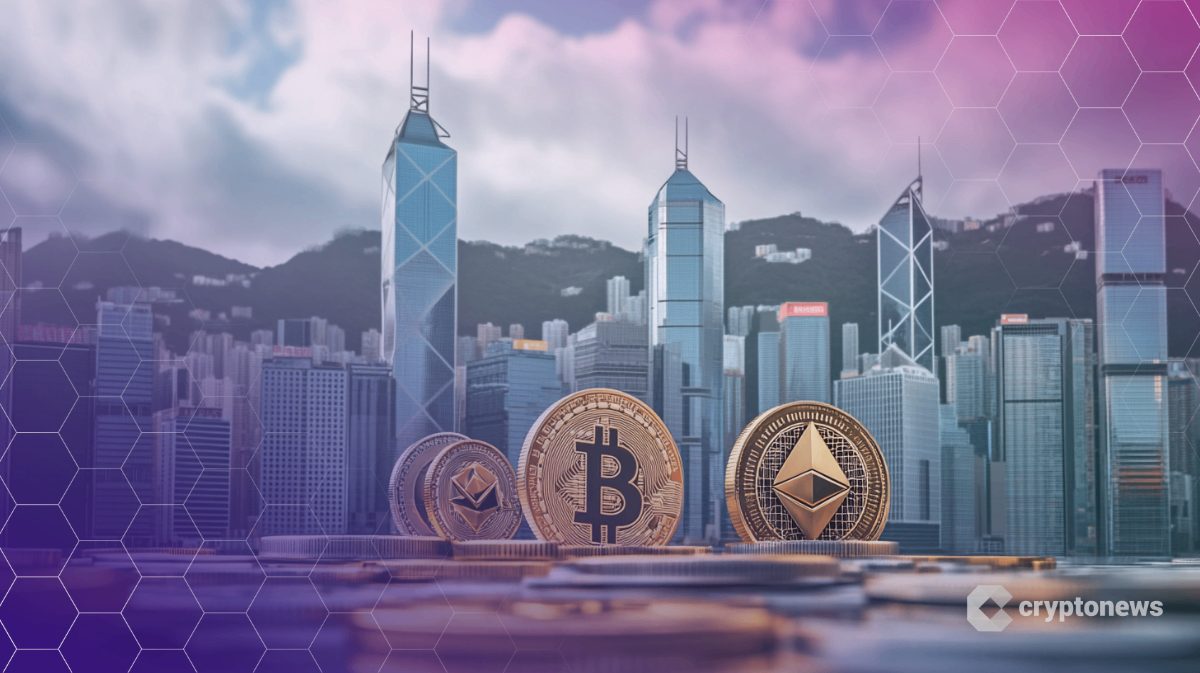
According to a Reuters report, the Hong Kong Financial Supervisory Authority (HKMA) is set to approve a license for the stablecoin issuer in March.
The development follows a regulatory review period and the unveiling of one of the most comprehensive stablecoin frameworks in the world, which went into effect in August last year.
At a meeting of the Legislative Council on Monday, Hong Kong Monetary Authority chief executive Eddie Yu said the review process had been completed, adding that initially only a very small number of applicants would be approved.
UA added that reviews focused on issues such as stablecoin usage, backup support, risk management and anti-money laundering controls.
Hong Kong's stablecoin era is off to a slow start as regulators tighten the bar
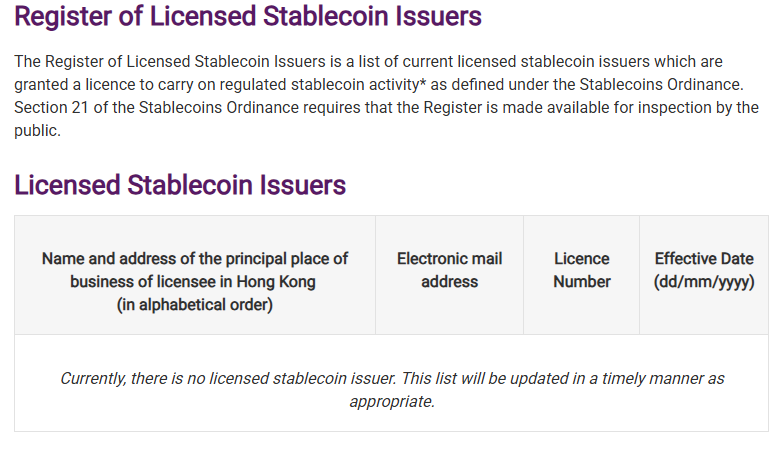
As of early February, no stablecoins have yet been authorized by Hong Kong's new regime.
HMA indicated it was reviewing 36 applications in the first round, although the wider industry demand had more than 40 potential applicants at one point.
The regulator has so far been cautious and has introduced a public register to monitor licensed issuers by July 2025, but the register is currently empty.
The licensing system, implemented in August, covers issuers of fiat-referenced stablecoins in Hong Kong and foreign tokens denominated in Hong Kong dollars.
The rules allow licensed issuers to issue, manage and redeem stablecoins, as long as they have full 1:1 high-quality and liquid asset support with authorized custodians.
Issuers must honor redemption requests within one business day at reasonable rates and are prohibited from paying interest to stablecoin holders.
Much attention has been paid to the administration and compliance.
According to the regulations, issuers must be domestically incorporated or authorized organizations with strong internal controls and independent boards of directors with specific compliance functions.
They must perform customer due diligence, use wallets and comply with anti-money laundering and anti-terrorist financing requirements.
The HMA has wide regulatory powers and can add additional conditions to the licence, introduce administrators or revoke the license in the event of breach of requirements.
Hong Kong's sandbox attracts banks, tech giants and Web3 companies
A number of high-profile companies have become major participants in applying for the HKMA's regulatory sandbox.
These include a joint venture between Standard Chartered's Hong Kong arm, Animoka Brands and telecom provider HTT, operating under the name Anchorpoint Financial.
Ant Group's digital technology division has confirmed it will pursue a license, with Bank of China Hong Kong reported as an applicant.
HSBC and ICBC also indicated an interest in applying last year, although HMA has not confirmed the identity of any applicants and has warned that earlier approvals should not be seen as endorsements of particular business models.
The stablecoin launch sits amid Hong Kong's extensive regulatory and strategic push to develop a full digital asset stack.
The city operates a Securities and Futures Commission licensing system for virtual asset trading platforms, with 11 exchanges already approved, including OSL, HashKey and Bullish.
Government officials have repeatedly developed stablecoins as infrastructure rather than speculative products.
At the World Economic Forum in Davos in January, Financial Secretary Paul Chan said Hong Kong's approach to crypto regulation is intended to be “responsible and sustainable,” describing digital finance as a strategic growth pillar for the city.
At the same time, industry groups have warned that increased enforcement costs could delay institutional participation if regulations become overly restrictive.
Trending news, recommended popular crypto topics, price predictions