Prediction markets beat social media by finding the truth, says Vitalik Buterin.

Crypto journalist
Anas Hasan

Crypto journalist


Share


Ethereum founder Vitalik Buterin has defended prediction markets against critics who see betting on real-world events as ethically questionable, arguing that these platforms offer social media superior truth-seeking methods while voicing concerns about their potential to encourage harm.
Writing on Farcaster, Buterin acknowledged that prediction markets could theoretically create incentives for malicious activity, but dismissed the risk in smaller markets covering larger events.
He pointed out that regular stock markets pose similar risks, and that political actors can benefit from risk simply by shorting stocks that are much larger than those on construction platforms.
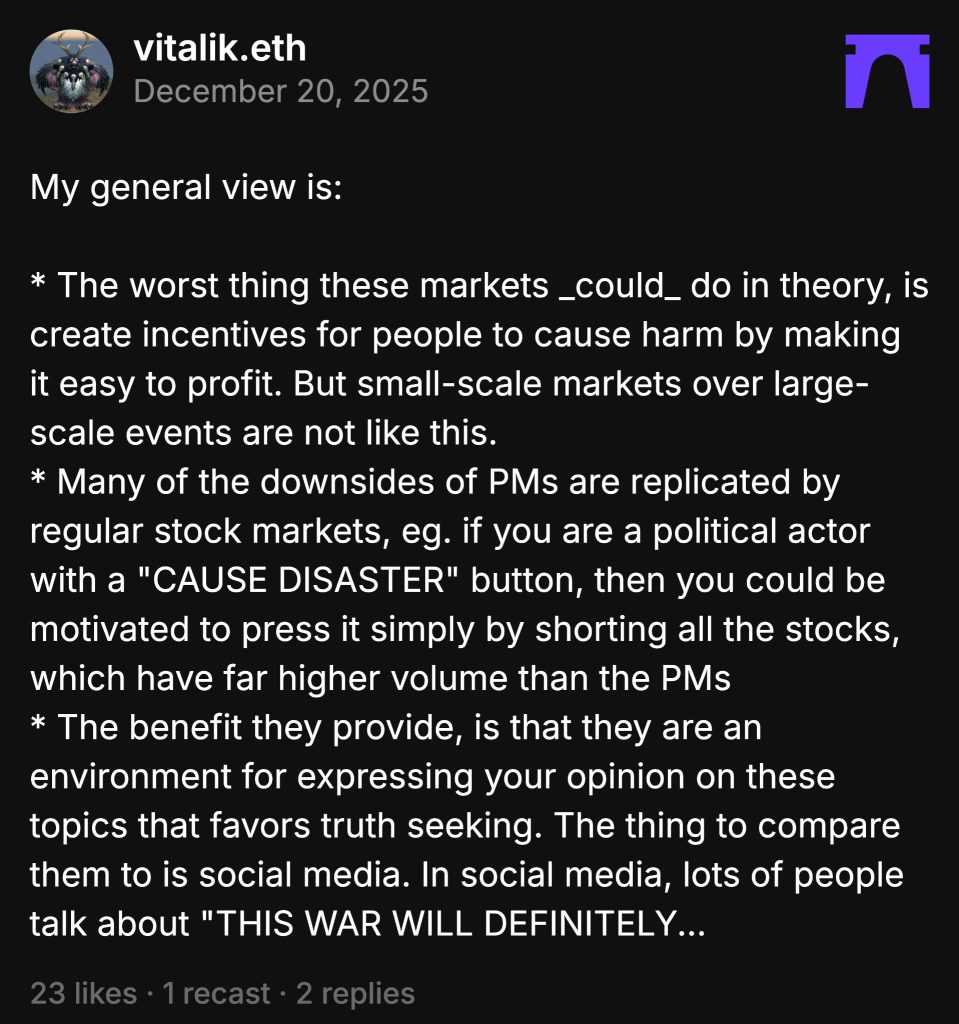
Buterin posits prediction markets as a solution to social media's fundamental accountability gap.
“The only thing they have to compare to is social media,” he writes, describing how platforms reward sensationalism over authenticity.
“In social networks, many people talk about ‘this war will definitely happen' and scare people, and there is no accountability: they gain popularity in the moment (and this club is often able to generate income!) and there is no accountability after the fact.”
Contrast this with prediction markets, where the financial stakes enforce truth-seeking.
“In speculative markets, if you make stupid bets, you lose, and the system (i) becomes more truth-seeking over time, and (ii) shows opportunities that reflect real uncertainty in the world more than these other systems,” Buterin explained.
Ethereum Founder Shares Personal Experiences Using Prediction Markets To Confirm Shocking News.
“I personally can read a news headline a few times, feel nervous, then check Polymarket prices and report with a sense of calm – people with experience in this topic know what's going on and there's only a 4% chance of something unusual happening,” he wrote.
Buterin defended it by comparing prediction markets to financial markets.
“I actually find that prediction markets are healthier to participate in than regular markets,” he said, “prices are bounded between 0 and 1, so they are subject to reflexive effects, the ‘great fool theory', pump-and-dump, etc.
A fierce ethical debate divides the industry
Buterin's defense sparked heated exchanges with critics, led by Quilibrium founder Cassie Heart, who argued that betting on death explains the mainstream hostility to crypto.
“I don't know Famine, but if I question the idea of gambling on whether more people will die, why is this industry hated by so many,” Hart wrote on Farcaster.
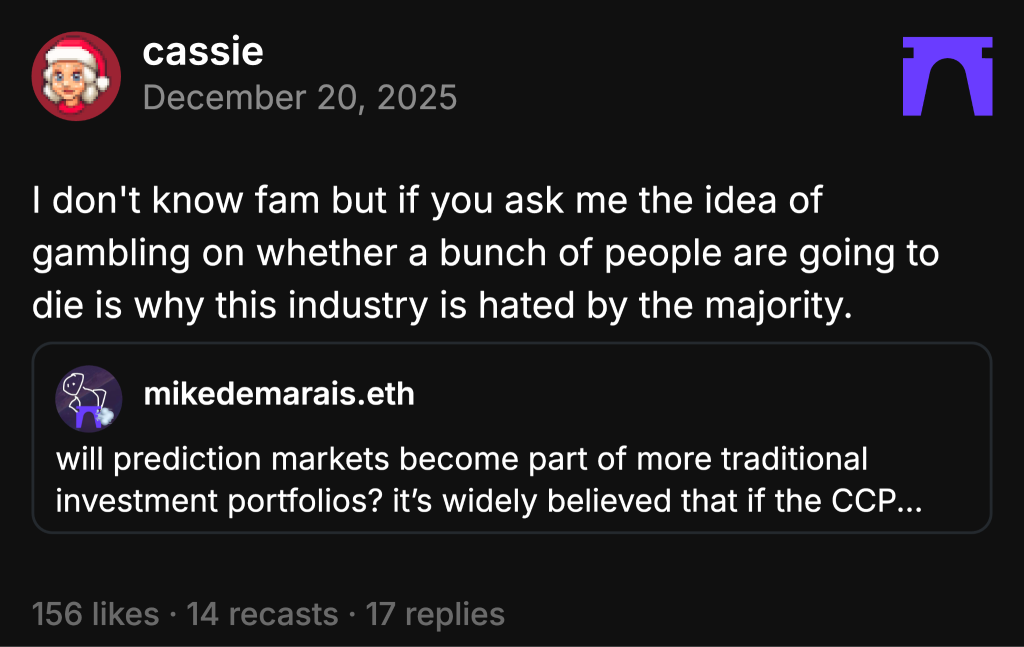
Her heart was filled with situations that provoked her criticism. “Maybe they'll start slapping sponsor tags on the missiles while we're gone,” she suggested.
“These kids are slaughtered because they have good bidders at Polymarket and Kalshi. Thanks Coinbase!”
While Buterin presented prediction markets as information tools, Heart directly challenged his framing.
“Okay, so here's my counter: a prediction market on whether someone will be killed or not to influence the outcome of the murder market,” Buterin said, asking if he accepted those results.
Other commenters provided historical context supporting the use of prediction markets.
One user mentions “Superforecasting,” noting that the NSA under Bush and Obama ran private forecasting markets, with participants working as data collectors outnumbering CIA and NSA operatives.
“We can have a moral argument about this, but short and sweet governments and people have been doing money transfers since the Dutch East India Company,” the user explained, adding that democracy has simply expanded access to more than elite bankers.
His heart completely rejected this defense. “Oh well, let's spend money killing people, that's much better,” she replied.
Rapid mainstream adoption continues
Despite the moral objections, prediction markets continue to expand into traditional finance.
Google Finance recently integrated live data from Polymarket and Kalshi, allowing users to query future events and view market opportunities alongside historical sentiment shifts.
Competition is intensifying as major exchanges rush into the sector.
Just last week, Coinbase filed a lawsuit in Michigan, Illinois and Connecticut to challenge the state's jurisdiction over prediction markets, citing that they will fall under the CFTC's exclusive jurisdiction before it launches with Kalshi in January 2026.
Chief Legal Officer Paul Grewal said, “Speculation markets are under the jurisdiction of the CFTC, not any government gaming regulator.”
Regulatory transparency also emerged when the CFTC granted no-action relief to Polymarket US, DaggerX, PredictIt and GeminiTitan earlier this month, reducing enforcement burdens by requiring full collateral and transparent trading information.
Trending news, recommended popular crypto topics, price predictions