Will Bitcoin repeat the crash of 2022?

Journalist
Hassan Shitu

Journalist


Share


Bitcoin is once again on the cusp of yet another critical inflection point as a key profitability indicator bounces back during one of the most painful periods in market history.
According to data from CryptoQuant analyst Adler AM, Bitcoin's net realized gains and losses have fallen by about 97% since hitting recent highs and are now approaching near-zero levels.
The situation is similar to what was seen before BTC dropped from about 30,000 to 16,000 in June 2022.
Net Realized P/L tracks the balance between profits and losses on the Bitcoin network based on on-chain spending. Positive readings indicate major profit making, while negative values reflect selling at a loss.
Readings near zero indicate that trades are taking place relative to price, indicating a lack of leverage and an imbalance between buyers and sellers.
Bitcoin selling pressure will ease, while buyers will remain on the sidelines.
The analyst pointed out that the current setup is similar to the one before Bitcoin's main capitation leg starts in 2022. In the year By the end of 2024 and the beginning of 2025, Net Realized P/L is projected to exceed $1.5 billion, indicating a level of high-temperature profitability.
In the year By January 26, 2026, that figure had fallen to about $60 million, fixed right at the zero line. In the year In 2022, the same return to zero did not mark the bottom.
Instead, the scale continued to dip into deep negative territory, as the price dropped another 50% to $350 million.
Adler notes that the current zero reading should not be interpreted as a bullish reversal signal. Rather, it represents a pause where selling pressure from profit-seekers has largely dried up, but fresh demand hasn't kicked in.
Data on the chain suggests that the market is currently being supported more by a lack of sellers than by strong buying demand, a weak balance that has historically been lower in risk-free areas.
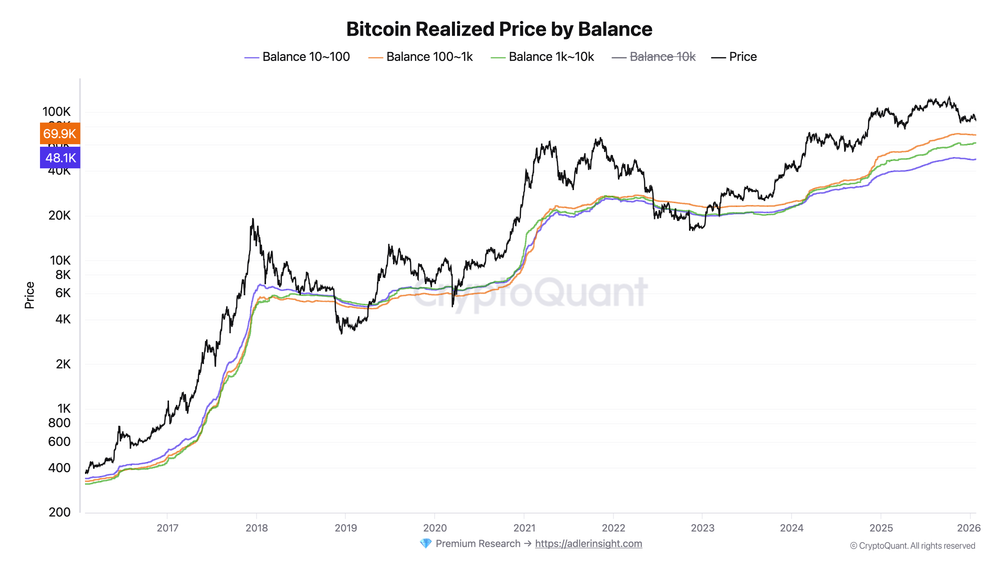
Despite the warning signs, large Bitcoin holders remain in the profits, as price data broken down by volume shows that all major whaling groups are still above their average acquisition costs.
Owners with a balance between 100 and 1,000 BTC have the highest realized value, close to $69,900, giving them a profit buffer of around 25% of the current price.
Other large groups, including wallets holding 10-100 BTC and more than 10,000 BTC, have an average entry price of around $48,000 and $51,000, respectively, with a 70% to 80% failure rate.
This helps explain the lack of panic selling, even though prices are pulling back significantly from recent highs.
Bitcoin slips below $88K as volatility increases.
At the time of writing, Bitcoin was valued at approximately $87,756, down approximately 1.1% over the past 24 hours and 5.7% over the past week.
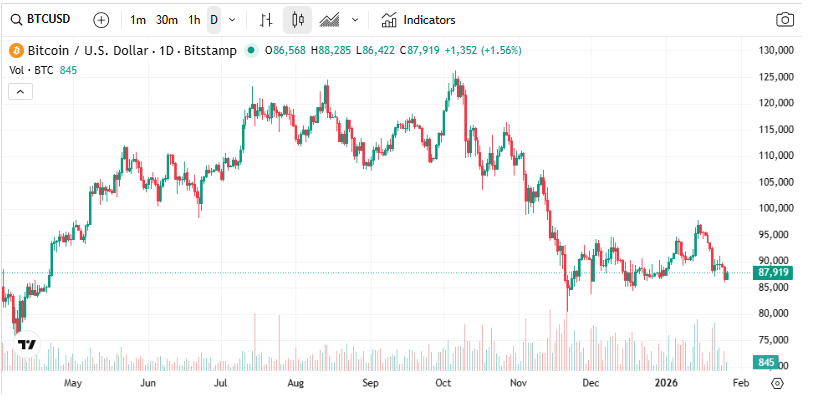
Trading volume, however, rose more than 160% on the day to $53.1 billion, reflecting heightened activity as traders traded in volatility.
Macro pressure has also contributed to the discomfort, with U.S. President Donald Trump threatening to impose 100% tariffs on any Canadian goods if Ottawa strengthens trade ties with China and reviving rumors of a possible U.S. government shutdown.
The move triggered the liquidation of more than $320 million of leveraged long positions within hours.
Also, CoinShares last week reported $1.73 billion in withdrawals from digital asset investment products.
Bitcoin-related products accounted for $1.09 billion of these flows, most of which came from remittances from the United States.
The exchange's order book data showed that selling products were engulfed by a modest volume delta, indicating controlled selling.
Analysts say liquidity is still stable, with no signs of an easing.
Trending news, recommended popular crypto topics, price predictions