After years of decline, Bitcoin core development will grow by 60%

Crypto journalist
Anas Hasan

Crypto journalist


Share


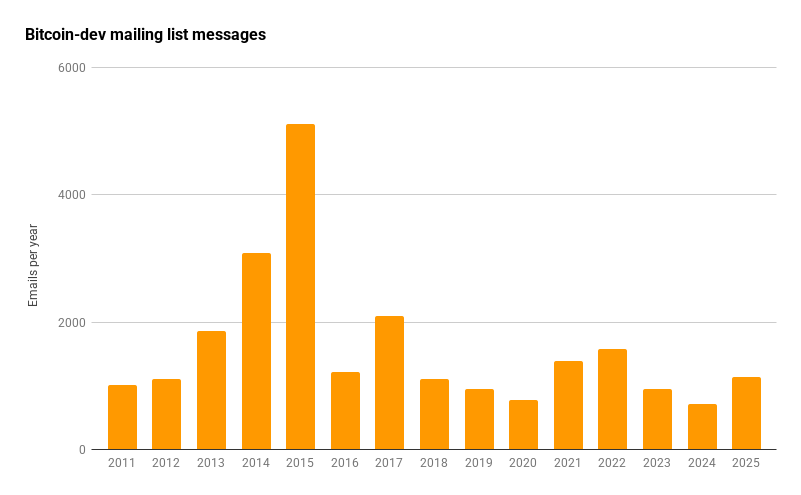
Bitcoin Core development activity jumped 60% in 2025 as measured by email volume to the Bitcoin development mailing list, reversing years of declining contributions and marking the most active period of development since the protocol's early years.
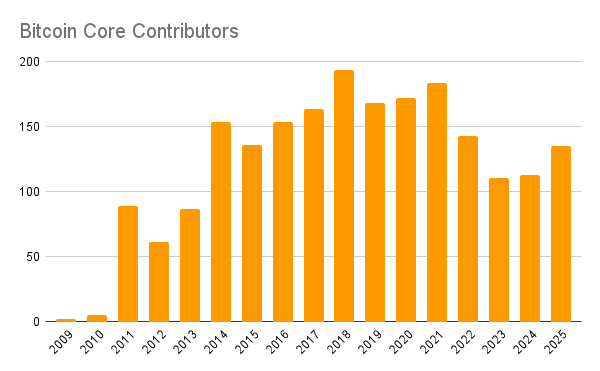
According to lead contributor James Lopp, 135 different developers contributed code changes totaling 285,000 lines, while Bitcoin transferred $4.5 trillion in value during the year, an average of $144,000 per second, according to CoinMetrics estimates.
The development renaissance unfolded against the backdrop of a philosophical battle over Bitcoin's core purpose, with several competing ideas emerging to address concerns about blockchain spam.
Meanwhile, the price of Bitcoin recovered above $92,000 due to the geopolitical shock in Venezuela on Monday as institutional funds returned to crypto markets with $646 million flowing into ETFs on the first trading day of 2026.
Network metrics show maturity despite price stability
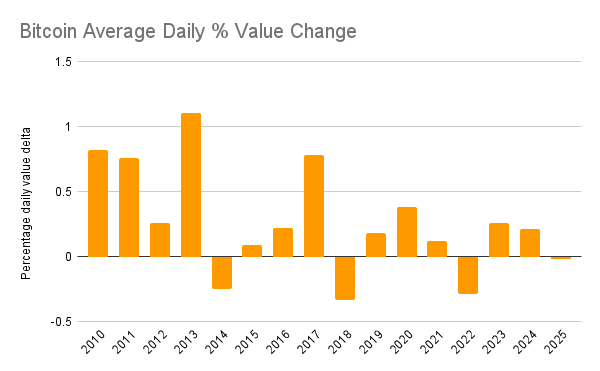
With an average daily price change of -0.02% in 2025, the expansion of the blockchain from 626.5 GB to 710.1 GB, and an annual growth rate of 13.3%, Bitcoin recorded its flattest year yet.
The network's UTXO pool has actually been reduced from 186.3 million to 165.8 million coins, thanks to efficiency improvements that remove one net UTXO every 1.5 seconds.
The network's hashrate increased by 32% from 802 to 1,060 exahash per second, while the number of reachable nodes increased by 18% to 24,298, according to Bitnodes data.
The median upper bandwidth for accessible nodes also dropped 39% to 6.6 megabits per second, while Bitcoin core code increased just 1% year-over-year to 2,541, showing more significant changes per commit.
Jameson Lopp, who compiles annual metrics, looks at trends in physical well-being.
“I predicted we would see an all-time high of hacking attacks in early 2025, averaging once a week. Unfortunately, that prediction has come true,” he wrote, referring to attempts at power theft targeting bitcoin holders.
As data storage arguments increase, so does adoption
According to the BTCmap catalog, merchant adoption will grow 53% by 2025, likely driven by Square's use of bitcoin payments in point-of-sale terminals.
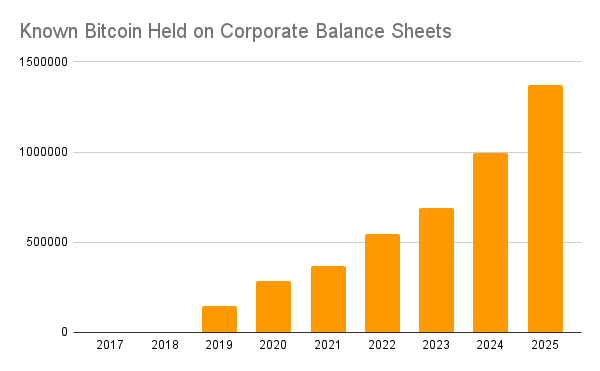
Corporate balance sheets also continue to reach all-time highs, with corporations now accounting for nearly 7% of the Bitcoin supply as institutional holdings accelerate.
Bitcoin OP_RETURN yields are down 47% year-on-year due to declining interest in the Runes protocol, which launched in 2024.
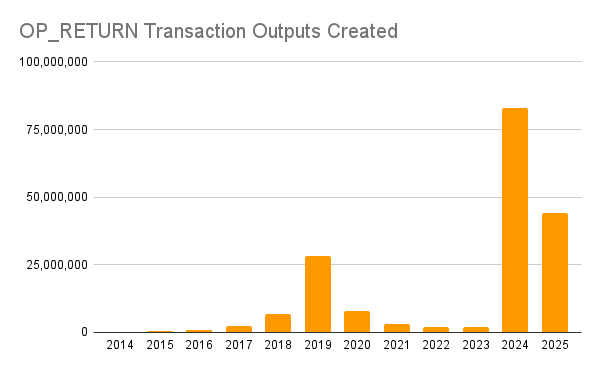
Despite this decline, 33 million records will be stored on the blockchain by 2025, a year-over-year increase of 58 percent. However, payout rates have remained surprisingly low, with the script paying just $12 million in total payouts.
The BSV fork lost another 64% to Bitcoin by 2025, now worth just 0.02% of the original protocol.
Lightning network capacity also quietly rose to 5,805 BTC after falling for most of the year, indicating renewed demand for the Layer 2 payment solution.
2025: the year of security audits and controversial reforms
Bitcoin Core completed its first public third-party security audit in November after 16 years of operation, with QuarkLab's 100-person-day review finding no critical vulnerabilities.
The audit, conducted by the Open Source Technology Improvement Fund and funded by Brink, identified two low-weight issues in peer-to-peer coverage, Mempool, and consensus logic.
A month ago, Bitcoin Core released version 30.0, removing the 80-byte OP_RETURN limit, increasing the default data carrier size to 100,000 bytes, and allowing multiple OP_RETURN outputs per transaction.
Adam Teback, Blockstream's CEO, defended the update as containing essential security fixes from “200 of the most skilled people on the planet,” while critics warned of spam threats and potential legal liabilities.
The update triggered the release of Bitcoin Knots, an alternative implementation that grew to represent 28% of network nodes.
In December, a proposal called “Cat” by developer Claire Ostrom also proposed to permanently ban cryptocurrencies and NFTs by marking them as not using their dust-sized derivatives, prompting co-contributor Greg Maxwell to call it “outright theft” of millions.
Bitcoin recovery follows geopolitical shock
Akshat Siddhant, quant analyst at Mudrex, has encouraged the growth of the Bitcoin community, saying institutional interest has returned strongly following the developments in Venezuela.
“If BTC closes above $93,700, the momentum can carry it to $100,000, with support near $88,500,” he said, adding that the fear-greed indicator remained neutral for the first time since October, when crypto ETFs attracted fresh capital.
At the time of writing, Bitcoin is at $92,861, up 1.64% in the last 24 hours.
Trending news, recommended popular crypto topics, price predictions