Coinbase CEO Raises Red Flags Against US Crypto Bill

Crypto Reporter
Shalini Nagarajan

Crypto Reporter


Share

Coinbase CEO Brian Armstrong said the exchange cannot support the new Senate crypto bill, in its current form, in Washington's latest attempt to set new ground rules for digital assets of uncertainty.
Senators introduced the bill earlier this week to clarify when tokens are considered securities or commodities, and to place crypto markets under regulation with the Commodity Futures Trading Commission, a long-standing priority for much of the industry.
After reviewing the text, Armstrong issued a protest on Wednesday, saying, “After reviewing the text of the Senate Banking bill over the past 48hrs, Coinbase unfortunately cannot support the bill as written.
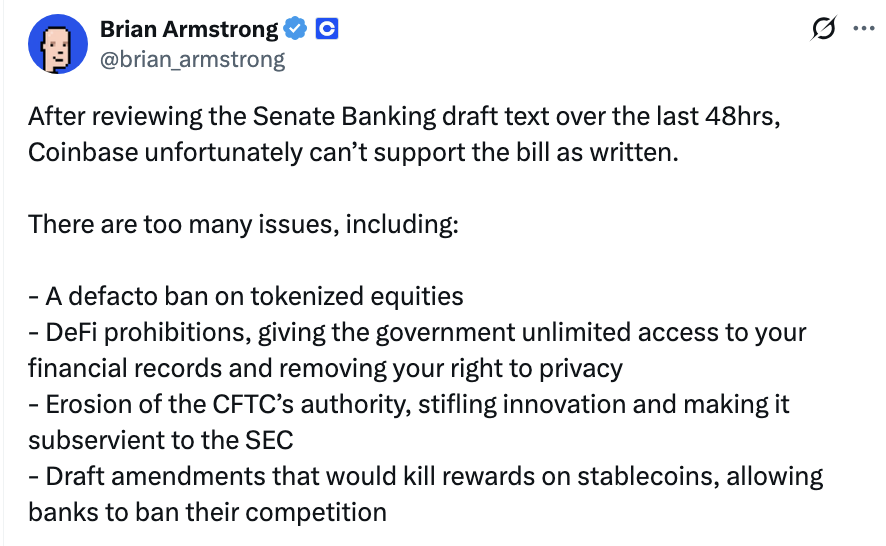
Image source: X/@brian_armstrong
Armstrong flags encryption, encryption and privacy threats
The draft contains a number of problems, including a de facto ban on tokenized shares, restrictions on decentralized finance and privacy, and changes that would weaken the CFTC in ways that could leave innovation at the mercy of the Securities and Exchange Commission.
Armstrong also took aim at provisions limiting the rewards associated with statscoins, a flashpoint in the lobbying battle between banks and crypto companies.
“We appreciate the efforts of members of the Senate to reach a bipartisan result, but this version would be materially worse than the current one. We would rather have no bill than a bad bill. We all hope to move toward a better bill.”
The bill would not allow crypto companies to pay interest to users just for holding stablecoins, although it would still allow rewards for certain activities, such as making payments or joining loyalty programs, according to disclosure rules set by the SEC and CFTC.
Bill takes a close look at the crypto industry as it enters a critical phase
Coinbase's position matters because the company has been a central voice in market structure negotiations and a big spender in pro-crypto political campaigns. Lawmakers were set to begin the Senate Banking Committee's amendment at 10 a.m. Thursday, but the meeting was postponed.
Separately, the Galaxy Senate Banking Bill said it would go further than the passage of the Digital Asset Market Transparency Act on illegal financing, and warned that the Treasury Department could expand access to crypto transfers through the authority of new special measures.
Galaxy likened that power to tools created by the Patriot Act after the Sept. 11 attacks, which could apply broadly to offshore locations and trading rails if the Treasury classifies certain jurisdictions, institutions or categories of transactions as a major money laundering risk.
As the Trump administration takes a more supportive tone toward parts of the industry and as lawmakers try to replace enforcement, pressure for the Senate framework has increased, leading to uncertainty over oversight, disclosure and market behavior.
For crypto markets, the next few days will set the temperature, either for lawmakers to keep the draft in place without softening the major platforms, or for the bill to be delayed again, leaving the industry to go through years of agency guidance and court battles.
Trending news, recommended popular crypto topics, price predictions