Perp DEXs can replace traditional banks.

Journalist
Hassan Shitu

Journalist


Share


Decentralized exchanges are moving from the fringes of crypto trading to the center of the market, as new data and Delphi Digital suggest these platforms can evolve into full-service financial spaces that challenge the roles traditionally held by banks.
The move comes as traders are still attracted to blockchain-based infrastructure, cutting out middlemen, cutting costs and working around the clock despite market volatility.
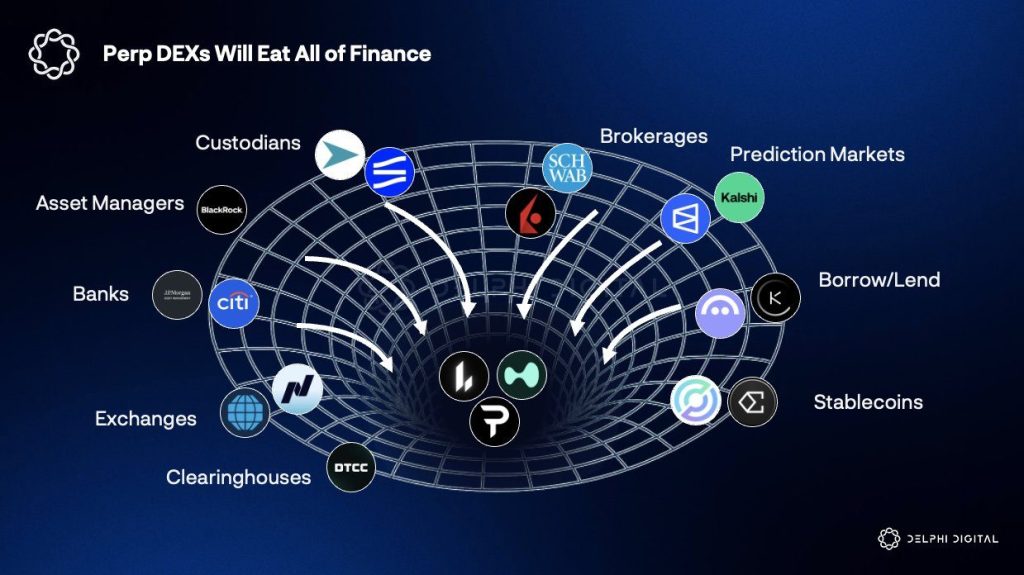
Perp DEXs allow users to trade perpetual futures contracts efficiently and with no expiration, a product historically dominated by centralized exchanges and traditional derivatives desks.
Perp DEXs as DeFi bundles trading, lending and protection
Delphi Digital's Vision 2026 This decentralized finance segment is positioned to take more market share from legacy financial products, with structural efficiencies that are difficult for traditional systems to replicate.
The research firm argued that legacy finance is fragmented and expensive to operate, while a decentralized infrastructure can connect multiple financial functions on a single chain.
In a post shared on X, Delphi Digital pointed to HyperLiquid's move into native lending as a key sign of where the sector is headed.
Delphi says this opens the door for Perp DEXs to function as integrated financial platforms, trading, custodial, clearing and lending within a single chain system.
Competing platforms such as Aster, Lighter and Paradex are now racing to develop similar capabilities.
This integration reflects a broader trend in crypto, where trading positions are expanding beyond execution into lending, custody and capital management.
The data shows that this transition is already well underway, as PerpDX has consistently taken revenue and volume share from central exchanges over the past three years.
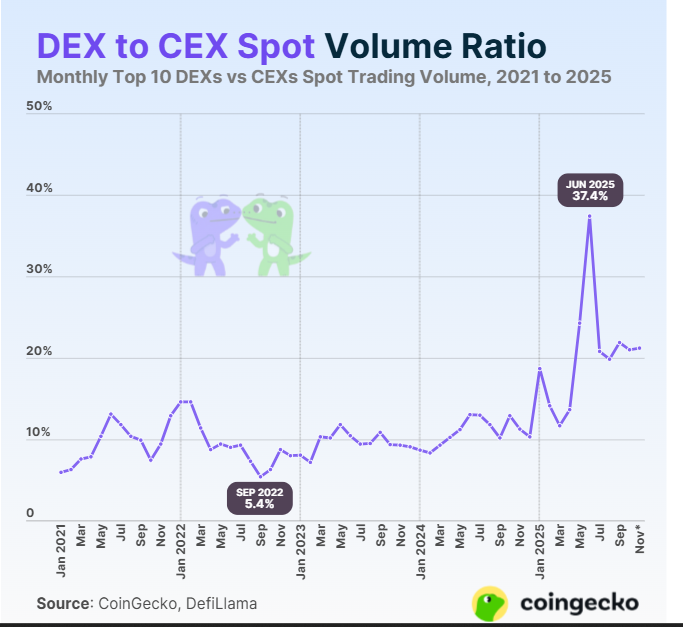
CoinGecko data shows that in January 2023, perp DEXs accounted for only 2.1% of centralized exchange perpetuity.
In the year By November 2025, this figure had risen to a record 11.7%, meaning that nearly one in every nine dollars in perpetual futures trades were executed on the decentralized platform.
For the full year, cumulative perp DEX volume doubled from $4.1 trillion in early 2025 to $12.09 trillion.
By 2025 itself, it will reach $7.9 trillion, which shows how quickly adoption has accelerated over the past year.
The sector is now locked in at over $20 billion in total value, with monthly volumes frequently exceeding $1 trillion and open interest hovering around $20 billion.
DEX spot trading will grow exponentially as the gap with CXX narrows
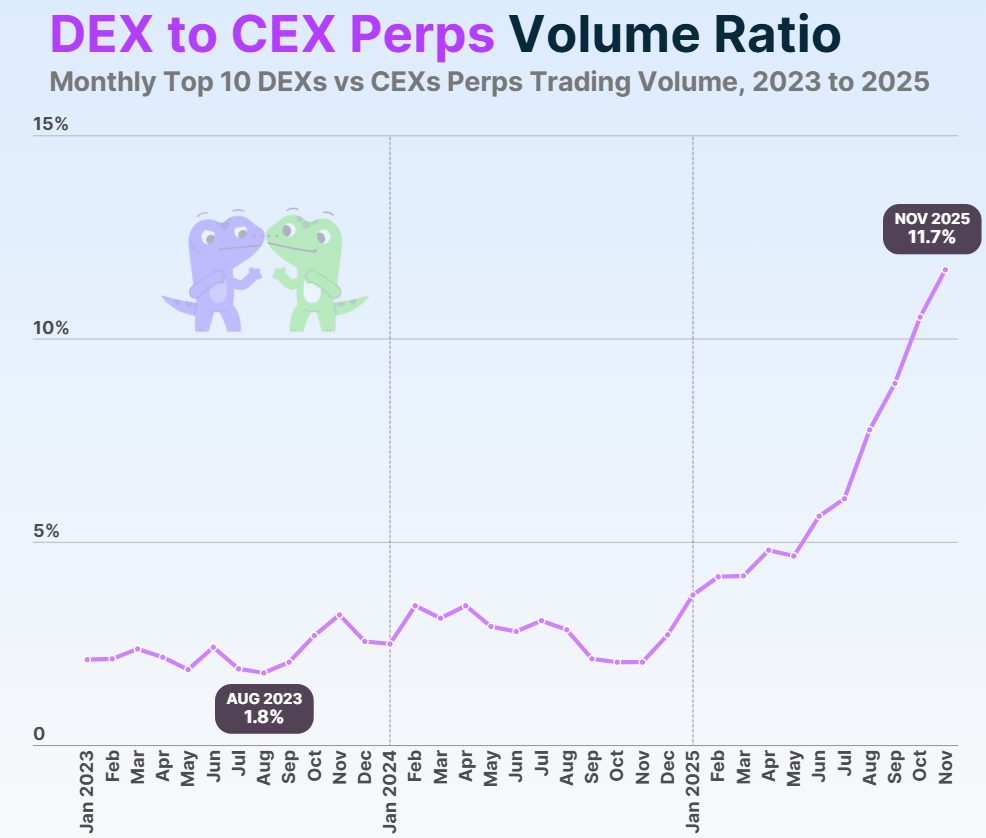
Spot trading followed a similar trend, albeit at a slower pace. Decentralized exchanges accounted for only 6.0% of point trading volume in January 2021 relative to centralized exchanges.
In the year That ratio rose to 21.2% in November 2025, reaching a peak of 37.4% in June 2025 due to memecoin speculation and activity on Pancake Swap.
At the same time, the report and surrounding data highlight how far the sector has to go.
At 12 trillion in annual transaction volume managed by DX, it is still lower than the 846 trillion notional value of over-the-counter products that could be reported by the bank in mid-2025.
Traditional banks retain advantages in regulatory transparency, fiat integration and services such as uncoordinated lending and consumer protection.
Industry observers note that each DX will need to expand beyond its results into lending, payments and real-world assets and define security, user experience and compliance to seriously challenge banks.
Many platforms are experimenting with on-chain ledgers, zero-fee models, incentive programs, and high-throughput blockchains to improve performance and accessibility.
Trending news, recommended popular crypto topics, price predictions